Road construction and maintenance in South Africa is tightly regulated. Every site that affects traffic flow — whether a pothole repair on a municipal road, a utility trench on a provincial route, or a major SANRAL highway project — must display the correct temporary road traffic signs before a single worker sets foot on the carriageway.
The standard that governs these signs is Chapter 13 of the SADC Road Traffic Signs Manual (SADC-RTSM). This guide covers what every South African road construction site needs, and why getting it wrong exposes contractors to serious liability.
Why Temporary Road Signs Are a Legal Requirement
Section 56 of the National Road Traffic Act requires that any person carrying out work on a public road must take adequate precautions to warn road users of the obstruction or hazard. The SADC-RTSM Chapter 13 provides the specific sign types, sizes, placement distances, and sequences that constitute adequate precaution.
A contractor who does not comply with Chapter 13 requirements:
- Fails to meet their duty of care to road users
- Exposes themselves to civil liability if a road user is injured or killed
- Risks a stop-work order from SANRAL, provincial roads, or the local municipality
- May face criminal prosecution under the National Road Traffic Act
The Road Construction Sign Sequence
A compliant temporary works zone requires signs in a specific sequence, placed in the order road users approach them:
Step 1: Advance Warning (before the works zone)
TW336 — Road Works Ahead Triangle. The primary advance warning sign. A large fluorescent orange equilateral triangle placed 150m–300m before the works zone (the distance depends on road speed limit and type).
Speed reduction signs (where applicable). If the works zone requires a lower speed limit, speed restriction signs are placed in the advance warning sequence before the taper.
Step 2: Zone Entry — Danger Plate
Danger Plate (fluorescent yellow diamond). The plain yellow diamond marks the start of the works zone. It is the first sign after the advance warning sequence. The danger plate has no symbol or text — it is purely a boundary marker.
For a detailed explanation, see: Danger Plate Road Signs in South Africa: What They Are and When to Use Them
Step 3: Within the Works Zone
TW702 — Worker Present. Placed within the works zone whenever workers are on the carriageway. A square sign with a fluorescent flag indicating human presence.
Cones and barriers. Traffic cones, water-filled barriers, and channelling devices define the works zone boundary for drivers. TW411 boom signs attach to barriers to improve visibility at night.
R1.5 Stop/Go Boards. Required whenever traffic is reduced to one lane and managed manually through alternating flow. Traffic controllers must be positioned at both ends of the single-lane section, each holding an R1.5 board.
Step 4: Zone Exit — Danger Plate
A second danger plate is placed at the end of the works zone, on the far side from approaching traffic. This marks the exit boundary of the hazard area.
Step 5: End of Restrictions
TW904 — End of Restrictions. Placed after the final danger plate, TW904 tells road users that the temporary restrictions are complete and normal road conditions resume.
Sign Sizes by Speed Limit
| Road Speed Limit | TW336 Triangle Size | Danger Plate Size |
|---|---|---|
| Up to 60 km/h | 600mm | 600mm |
| 60–100 km/h | 900mm | 900mm |
| Over 100 km/h | 1200mm | 1200mm |
Using undersized signs on a higher-speed road is a SADC-RTSM non-compliance finding, even if all the required sign types are present.
Reflective Sheeting: Class 1 vs Class 2
All temporary road signs must use retro-reflective sheeting so they are visible to drivers at night. SADC-RTSM Chapter 13 specifies:
- Class 1 (standard): Suitable for lower-speed roads and urban environments with good ambient lighting
- Class 2 (high-intensity prismatic): Required for national roads, high-speed routes, and any site where night works occur
Using Class 1 sheeting on a national road when Class 2 is required is a specification non-compliance.
Common Road Construction Sign Compliance Failures
Based on SANRAL and provincial roads inspection findings:
- Missing danger plates — the TW336 triangle is present but the zone boundary markers are absent
- Undersized TW336 — a 600mm triangle on a 100km/h road
- Class 1 sheeting on a national road where Class 2 is required
- No TW904 end of restrictions sign at the exit of the works zone
- R1.5 Stop/Go boards absent on a single-lane alternating section
- TW702 worker present signs missing while workers are on the carriageway
Road Construction Sign Requirements by Site Type
| Site Type | Required Signs | Governing Standard | Enforcement Body |
|---|---|---|---|
| SANRAL National Road | TW336 (1200mm Class 2), danger plates (1200mm Class 2), TW702, TW904, R1.5 Stop/Go boards (where applicable), TW411 boom signs for night works | SADC-RTSM Chapter 13, National Road Traffic Act s.56 | SANRAL |
| Provincial Road | TW336 (900mm–1200mm, Class 1 or 2 per speed limit), danger plates, TW702, TW904, R1.5 Stop/Go boards (where applicable) | SADC-RTSM Chapter 13, National Road Traffic Act s.56 | Provincial Roads Department |
| Municipal Road | TW336 (600mm–900mm per speed limit), danger plates, TW702, TW904, R1.5 Stop/Go boards (where applicable) | SADC-RTSM Chapter 13, Municipal By-laws | Local Municipality / Traffic Department |
| Private Construction Site (road access affected) | TW336 advance warning, danger plates at access points, TW702 where workers interact with public roads, directional signage | SADC-RTSM Chapter 13, OHS Act | Municipality, OHSA Inspector |
Frequently Asked Questions
What road signs are legally required on a South African construction site?▼
Under Section 56 of the National Road Traffic Act and SADC-RTSM Chapter 13, all road construction sites affecting traffic must display a TW336 advance warning triangle, danger plates at the zone entry and exit boundaries, TW702 worker present signs when workers are on the carriageway, and a TW904 end of restrictions sign at the exit. Where traffic is reduced to a single lane, R1.5 Stop/Go boards managed by trained traffic controllers are also required.
Who enforces road construction sign compliance in South Africa?▼
Enforcement depends on the road category. SANRAL enforces compliance on national roads, provincial roads departments enforce on provincial routes, and municipalities enforce on local roads. Traffic officers and inspectors from these authorities can issue stop-work orders, require immediate remediation, or issue fines for non-compliant signage. Contractors on SANRAL projects are subject to the most rigorous compliance inspections.
What is the minimum sign setup for a small road maintenance job?▼
Even a small pothole repair on a public road requires a minimum of a TW336 advance warning triangle at the correct placement distance, a danger plate at the start of the works zone, TW702 worker present signs while workers are on the road, a second danger plate at the exit of the works zone, and a TW904 end of restrictions sign. If the repair narrows traffic to a single lane, R1.5 Stop/Go boards and trained traffic controllers are also required.
What are the penalties for non-compliant road construction signage in South Africa?▼
Penalties for inadequate road construction signage include stop-work orders, fines under the National Road Traffic Act, and contract termination on government projects. More significantly, if a road user is injured or killed in a zone with non-compliant signage, the contractor faces civil liability claims for damages. In cases of gross negligence, criminal prosecution is also possible under South African law.
Do I need Class 2 reflective signs for daytime road construction?▼
SADC-RTSM Chapter 13 requires Class 2 high-intensity prismatic reflective sheeting for all signs on national roads and high-speed routes, regardless of whether work occurs during the day or at night. For lower-speed urban roads with good ambient lighting, Class 1 sheeting may be acceptable for daytime work, but Class 2 is always required if any night works occur. When in doubt, specifying Class 2 for all sites eliminates the risk of a specification non-compliance finding.
How far in advance must warning signs be placed before a road works zone?▼
Under SADC-RTSM Chapter 13, the TW336 advance warning triangle must be placed 150m to 300m before the works zone, with the exact distance depending on the road’s speed limit and type. On roads with a 60 km/h or lower speed limit, 150m is the minimum; on higher-speed routes, a greater distance is required to give drivers adequate reaction time. Speed reduction signs, where required, must be placed in sequence between the advance warning sign and the zone entry danger plate.
Where can I buy a complete road construction sign kit in South Africa?▼
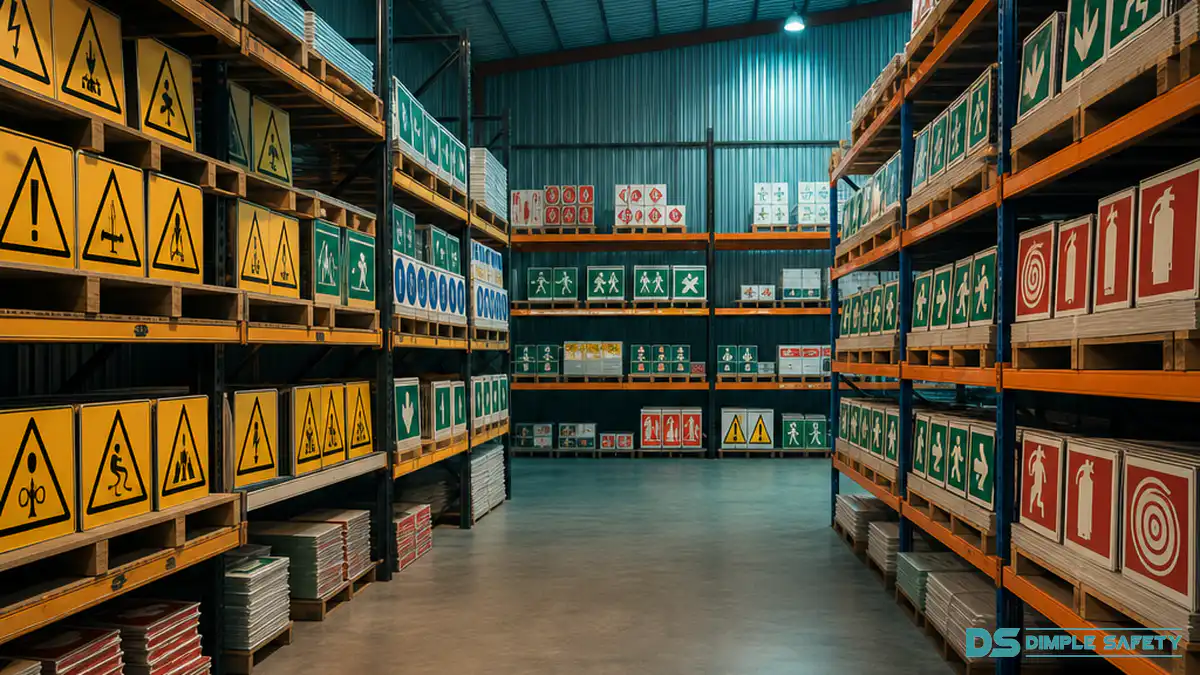
Dimple Safety stocks the complete SADC-RTSM Chapter 13 sign range from its Booysens, Johannesburg warehouse, including TW336 triangles (600mm, 900mm, 1200mm), danger plates, R1.5 Stop/Go boards, TW702 worker present signs, TW411 boom signs, and TW904 end of restrictions signs. All sizes are available in Class 1 and Class 2 reflective sheeting. Call 011 493 3000 or visit dimplesafety.co.za to order or arrange same-day collection.
Where to Buy Road Construction Signs in South Africa
Dimple Safety stocks the complete road construction sign range from our Booysens, Johannesburg warehouse:
- TW336 triangles — 600mm, 900mm, 1200mm — Class 1 and Class 2 reflective
- Danger plates — 600mm, 900mm, 1200mm
- R1.5 Stop/Go boards
- TW702 worker present signs
- TW411 boom signs
- TW904 end of restrictions
Available for same-day collection from Booysens or nationwide delivery. We supply municipalities, SANRAL contractors, civil engineering companies, and utility service providers.
📞 011 493 3000 | 🌐 dimplesafety.co.za | 📍 22 Fraser Street, Booysens, Johannesburg