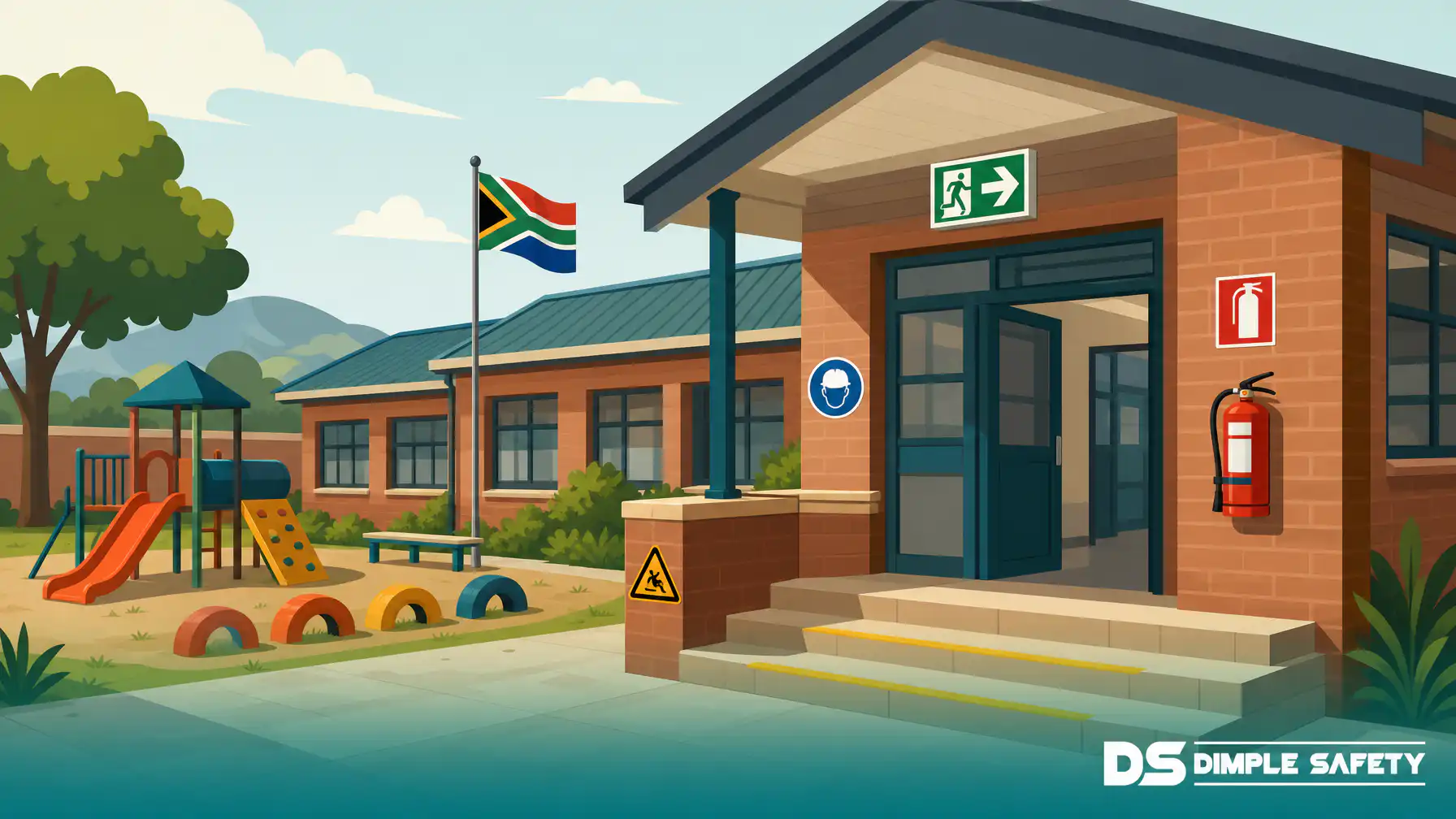
Walk into any compliant South African workplace and you will see them: a yellow triangle warning of a hazard, a red circle banning an action, a blue circle telling you what to wear. These signs are not random — they follow a strict visual system defined by SANS 1186, South Africa’s national safety sign standard.
Understanding the five sign categories helps SHE representatives audit workplaces correctly, helps purchasing managers order the right signs, and helps workers know what each sign means at a glance.
Why Shape and Colour Matter
SANS 1186 — and the international standard it is based on, ISO 7010 — uses a system of shapes and colours because shape and colour communicate faster than text. Even before a worker reads the symbol on a sign, the shape tells them: is this a warning? Is something prohibited here? Where is the safe exit?
This matters most in emergencies, when there is no time to read.
Category 1: Warning Signs
Shape: Equilateral triangle Background: Yellow Border and symbol: Black
Warning signs indicate that a hazard or dangerous condition is present. They are the most commonly needed sign category because every active hazard requires a warning sign.
Common warning signs in South African workplaces:
- Electrical hazard / high voltage
- Forklift and vehicle operating area
- Flammable materials storage
- Wet or slippery floor
- Overhead hazard (falling objects)
- Chemical or corrosive substance area
Key rule: Warning signs go at the hazard, not at the building entrance. Place them where the specific danger exists.
Category 2: Prohibition Signs
Shape: Circle with diagonal bar Background: White Circle and bar: Red Symbol: Black
Prohibition signs tell workers and visitors that a specific action is not permitted in that area.
Common prohibition signs:
- No smoking
- No entry — unauthorised persons
- No open flame
- No mobile phones
- Do not operate this equipment
Key rule: Place prohibition signs at the point of restriction, not just at the building entrance unless the prohibition applies to the entire area.
Category 3: Mandatory Action Signs
Shape: Circle Background: Blue Symbol: White
Mandatory signs require a specific action or behaviour in that zone. These are most commonly used at the entry points to work areas where PPE is required.
Common mandatory signs:
- Hard hat must be worn
- Safety footwear required
- Eye protection required
- Hearing protection required
- High-visibility vest required
- Hand washing required before proceeding
Key rule: Mandatory signs must be placed at the point where the requirement begins — typically the entrance to a construction site, machine room, laboratory, or any area with a specific PPE requirement.
Category 4: Safe Condition Signs
Shape: Rectangle or square Background: Green Symbol: White
Safe condition signs indicate emergency exits, safe routes, first aid, and the location of safety equipment. In an emergency — fire, power failure, evacuation — these signs guide workers to safety.
Common safe condition signs:
- Emergency exit with directional arrow
- First aid point
- Emergency assembly point
- Eye wash station
- Emergency shower
- Stretcher location
Key rule: Emergency exit signs must be visible from every point in a building. SANS 10400-T (South Africa’s fire protection standard) requires that exit signs are visible from a maximum of 30 metres in normal conditions and requires photoluminescent exit signs in certain building types, including buildings over four storeys and enclosed car parks.
Category 5: Fire Equipment Signs
Shape: Rectangle or square Background: Red Symbol: White
Fire equipment signs indicate the location of fire-fighting equipment. Every fire extinguisher, fire hose reel, fire alarm call point, and fire blanket must have a corresponding sign.
Common fire equipment signs:
- Fire extinguisher (with type indicated: DCP, CO2, foam)
- Fire hose reel
- Fire alarm call point / break glass
- Fire blanket
Key rule: Fire extinguisher backing boards — a red board mounted behind the extinguisher — serve as both a physical anchor and a location sign. Many South African buildings use both a backing board and an overhead directional sign for maximum visibility.
Quick Reference: 5 Types of Safety Signs
| Type | Shape | Background | Symbol Colour | Examples | Where Used |
|---|---|---|---|---|---|
| Warning | Equilateral triangle | Yellow | Black | Electrical hazard, forklift area, wet floor | Hazard zones, machinery areas, chemical storage |
| Prohibition | Circle with diagonal bar | White | Red (circle/bar), Black (symbol) | No smoking, no entry, no open flame | Access control points, restricted areas |
| Mandatory | Circle | Blue | White | Hard hat required, eye protection, hi-vis vest | PPE entry points, construction sites, laboratories |
| Safe Condition | Rectangle or square | Green | White | Emergency exit, first aid point, assembly point | Corridors, stairwells, emergency routes |
| Fire Equipment | Rectangle or square | Red | White | Fire extinguisher, fire hose reel, break glass | All fire equipment locations throughout building |
How to Audit Your Workplace
A practical SANS 1186 audit works through five questions:
- Have all active hazards been identified and warning signs placed?
- Are all restricted areas and prohibited actions signed correctly?
- Are mandatory PPE requirements signed at every entry point to the relevant zone?
- Are all emergency exits and first aid stations clearly signed — including in low light or darkness?
- Does every piece of fire equipment have a sign, and are those signs maintained and undamaged?
Any gap in these five areas is a non-compliance finding under the OHS Act General Safety Regulations.
Frequently Asked Questions
What are the 5 types of safety signs used in South African workplaces?▼
The five types are warning (yellow equilateral triangle), prohibition (red circle with diagonal bar), mandatory (blue circle), safe condition (green rectangle), and fire equipment (red rectangle). All five are defined by SANS 1186, South Africa’s national safety sign standard, and are legally required under the OHS Act General Safety Regulations.
What colour is a prohibition sign in South Africa?▼
A prohibition sign has a white background with a red circle and diagonal bar over a black symbol. This colour system is specified by SANS 1186 and follows the international standard ISO 7010. Common examples include no smoking, no entry, and no open flame signs.
What does a blue circle safety sign mean?▼
A blue circle is a mandatory action sign under SANS 1186. It means a specific action is required in that area, most commonly PPE requirements such as hard hats, safety footwear, eye protection, or high-visibility vests. Mandatory signs are typically placed at the entry points to hazardous work areas.
What shape is a warning sign in South Africa?▼
Warning signs are equilateral triangles with a yellow background, black border, and black symbol. This shape is specified by SANS 1186 and is consistent with the international ISO 7010 standard. The triangle shape is internationally recognised as indicating a hazard or dangerous condition.
Are safety signs legally required in all South African workplaces?▼
Yes. Regulation 9 of the OHS Act General Safety Regulations requires all employers to indicate hazards, prohibited zones, and safe areas by means of safety signs. This applies to virtually all South African workplaces, and failure to display the correct signs is a non-compliance finding during a Department of Labour inspection.
What is a safe condition sign and when is it required?▼
A safe condition sign (green rectangle with white symbol) indicates emergency exits, first aid stations, assembly points, and safe routes. They are required wherever people need to be guided to safety during an emergency, and SANS 10400-T requires that exit signs are visible from every point in a building within a maximum distance of 30 metres.
Where can I buy all 5 types of safety signs in one place in South Africa?▼
Dimple Safety stocks all five SANS 1186 sign categories — including standard and photoluminescent versions — from its Booysens, Johannesburg warehouse. Over 90% of the range is available for same-day collection. Nationwide delivery is also available. Visit dimplesafety.co.za or call 011 493 3000.
Order All 5 Sign Categories from Dimple Safety
Dimple Safety stocks all five SANS 1186 sign categories — standard and photoluminescent — from our Booysens, Johannesburg warehouse. 90% of the range is in stock for same-day collection.
📞 011 493 3000 🌐 dimplesafety.co.za 📍 Booysens, Johannesburg