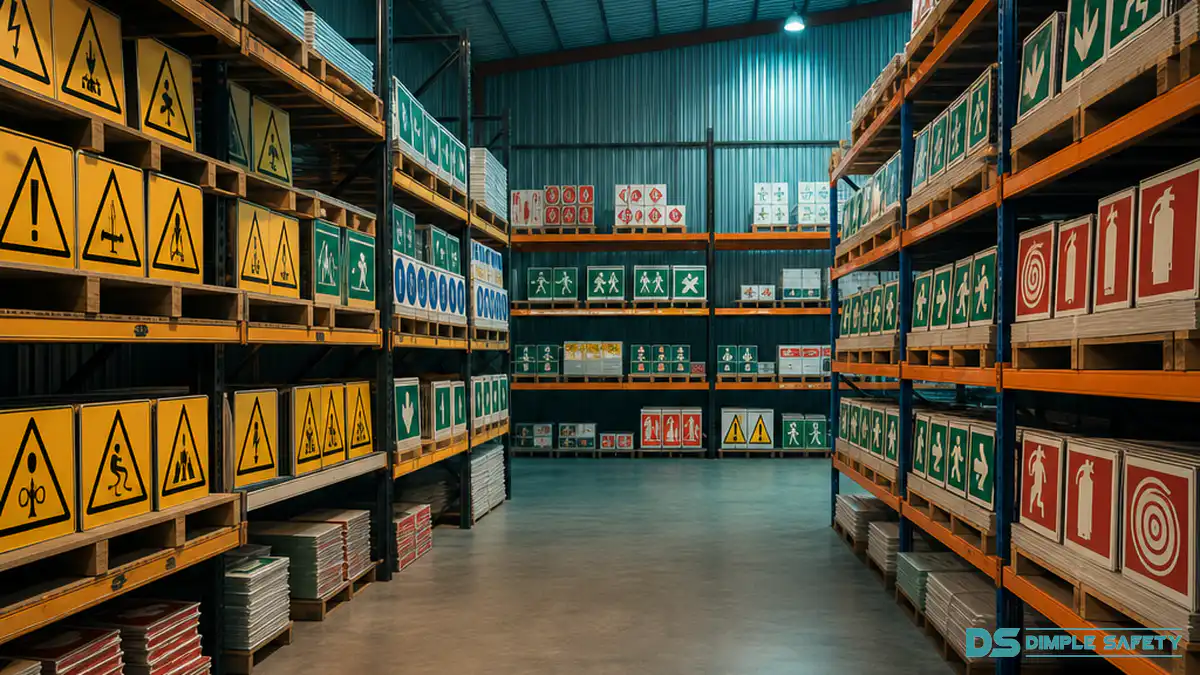
A warehouse presents more types of simultaneous hazard than almost any other work environment: forklifts moving at speed alongside pedestrian workers, racking systems at height, receiving bays with truck movement, chemical storage, and often a building layout that makes emergency evacuation complex.
The Occupational Health and Safety Act (OHS Act 85 of 1993) and SANS 1186 require that every active hazard in your warehouse be identified with the correct safety sign. This guide covers the full signage requirements for South African warehouses and distribution centres.
OHS Act Requirements for Warehouse Signage
Under Regulation 9 of the OHS Act General Safety Regulations, employers must indicate all hazards, prohibited activities, mandatory actions, and safe conditions by means of SANS 1186-compliant safety signs. This obligation applies to every workplace, including warehouses, regardless of size.
Key OHS Act signage obligations:
- Warning signs at all active hazard zones
- Prohibition signs where specific activities are not permitted
- Mandatory signs at all PPE entry points
- Safe condition signs marking every emergency exit and evacuation route
- Fire equipment signs above every fire extinguisher, hose reel, and alarm call point
For a full breakdown of the five sign categories: The 5 Types of Safety Signs in South Africa
Forklift and Vehicle Movement Zones
The highest-risk area in most warehouses is the active forklift zone. Required signs:
Warning Signs (Yellow Triangle)
- Forklift operating area — placed at every entrance to an active forklift zone
- Pedestrian crossing — at all pedestrian crossing points across vehicle lanes
- Overhead hazard — at racking areas where overhead work is conducted
- Uneven ground / step — at ramp or grade changes in the floor
Mandatory Signs (Blue Circle)
- High-visibility vest required — at entry to all forklift operating areas
- Safety footwear required — at all warehouse entry points
- Hard hat required — in areas with active overhead operations
Prohibition Signs (Red Circle)
- No pedestrians — in designated vehicle-only zones
- No unauthorised persons — at restricted stock areas and dangerous goods storage
Key rule: Pedestrian and vehicle routes must be clearly separated with floor markings and signage. OHS Act inspectors look for this separation as a standard check in any warehouse inspection.
Racking and High-Bay Storage Areas
High-bay racking presents specific hazards. Required signs:
- Overhead hazard warning sign — at base of all racking systems where overhead work or loading occurs
- Maximum load sign — on every racking bay (required by Construction Regulations for racking systems)
- Hard hat required (mandatory) — in active picking zones where overhead movement occurs
- No access to damaged racking (prohibition) — displayed on any racking bay that has been damaged and quarantined
Loading Bays and Receiving Areas
- Vehicle movement warning — at pedestrian entry to the loading bay area
- Hi-vis vest required (mandatory) — at all loading bay entry points
- Speed restriction signs — post internal road speed limits where applicable
- No unauthorised vehicles (prohibition) — at the bay entrance if access is restricted
Emergency Exit Signs and Evacuation Routes
Large-footprint distribution centres require careful evacuation route planning:
- Emergency exit sign (green rectangle) — above every emergency exit door, with directional arrows at every aisle junction on the evacuation route
- Photoluminescent exit signs — in any enclosed area or section of the warehouse where emergency lighting may fail during load shedding
- Assembly point sign — at the designated external gathering point
- Maximum of 30 metres — no point in the warehouse should be more than 30 metres from a visible emergency exit sign (SANS 10400-T)
For load-shedding-prone warehouses: Photoluminescent Exit Signs South Africa
Fire Equipment Signs
Every fire extinguisher, hose reel, and fire alarm call point requires a corresponding sign:
- Fire extinguisher location sign — red rectangle, above every extinguisher
- Fire extinguisher backing board — red board behind the extinguisher
- Fire hose reel sign — red rectangle, above every hose reel
- Fire alarm call point sign — at every break-glass alarm point
- Fire blanket sign — in any kitchen or tea area within the warehouse
OHS Act inspections commonly find fire extinguishers without backing boards or overhead signs — the equipment is present but unsigned.
Chemical and Dangerous Goods Storage
Warehouses storing flammable liquids, compressed gases, or hazardous chemicals have additional signage requirements under the Hazardous Chemical Substances (HCS) Regulations:
- Flammable materials warning sign — at any storage area containing flammable liquids
- No open flame / no smoking (prohibition) — at all flammable storage areas
- Chemical hazard warning signs — specific to the substance stored
- MSDS location sign — indicating where Material Safety Data Sheets are accessible
Warehouse Safety Sign Requirements by Zone
The table below provides a zone-by-zone summary of the safety signs required in a South African warehouse or distribution centre, the sign types applicable, and the governing standard for each zone.
| Zone | Required Signs | Sign Type | Governing Standard |
|---|---|---|---|
| Loading bay | Vehicle movement warning, Hi-vis vest required, Speed restriction, No unauthorised vehicles | Warning (yellow triangle), Mandatory (blue circle), Prohibition (red circle) | SANS 1186 / OHS Act Reg. 9 |
| Forklift area | Forklift operating area, Pedestrian crossing, Hi-vis vest required, No pedestrians | Warning (yellow triangle), Mandatory (blue circle), Prohibition (red circle) | SANS 1186 / OHS Act Reg. 9 |
| Racking / storage | Overhead hazard warning, Maximum load sign, Hard hat required, No access to damaged racking | Warning (yellow triangle), Mandatory (blue circle), Prohibition (red circle) | SANS 1186 / Construction Regulations |
| Fire equipment | Fire extinguisher location, Fire extinguisher backing board, Fire hose reel, Fire alarm call point, Fire blanket | Fire equipment (red rectangle) | SANS 1186 / Local fire by-laws |
| Pedestrian walkways | Pedestrian route, Safety footwear required, Watch your step / uneven ground | Safe condition (green rectangle), Mandatory (blue circle), Warning (yellow triangle) | SANS 1186 / OHS Act Reg. 9 |
| Chemical storage | Flammable materials warning, No open flame, No smoking, Chemical hazard warning, MSDS location sign | Warning (yellow triangle), Prohibition (red circle) | SANS 1186 / HCS Regulations |
| Emergency exits | Emergency exit (with directional arrows at every aisle junction), Assembly point, Photoluminescent exit signs | Safe condition (green rectangle) | SANS 10400-T / SANS 1186 |
A Practical Warehouse Signage Audit
Work through these five questions:
- Is every forklift zone signed with both a warning sign and a mandatory hi-vis sign?
- Are all emergency exits signed with directional arrows at every aisle junction?
- Does every fire extinguisher have a backing board and overhead sign?
- Are all chemical storage areas signed for the specific hazard?
- Are all mandatory PPE entry signs at the correct point of entry — not just at the building entrance?
Any gap in these five areas is a non-compliance finding under OHS Act Regulation 9.
Frequently Asked Questions
What safety signs are legally required in a South African warehouse?▼
Under Regulation 9 of the OHS Act General Safety Regulations, every employer must display SANS 1186-compliant safety signs for all active hazards, prohibited activities, mandatory PPE requirements, safe conditions (including emergency exits), and fire equipment locations. In a warehouse context, this means warning signs in forklift and vehicle zones, mandatory PPE signs at all entry points, emergency exit signs on every evacuation route, and fire equipment signs above every extinguisher and hose reel. Compliance is required regardless of warehouse size.
Do forklift zones need specific safety signs in South Africa?▼
Yes. Every entrance to an active forklift zone must display a Forklift Operating Area warning sign (yellow triangle) and a Hi-Visibility Vest Required mandatory sign (blue circle) as a minimum. Vehicle-only lanes must carry No Pedestrians prohibition signs, and all pedestrian crossing points across vehicle lanes require a Pedestrian Crossing warning sign. OHS Act inspectors specifically check for this signage combination during warehouse inspections.
How many emergency exit signs does a warehouse need?▼
SANS 10400-T requires that no point in the building be more than 30 metres from a visible emergency exit sign. In practice, a large distribution centre needs an emergency exit sign above every emergency exit door plus directional arrow signs at every aisle junction along the evacuation route, so that a worker at any point in the warehouse can immediately identify the direction of the nearest exit. Photoluminescent exit signs are recommended for enclosed areas where emergency lighting may fail during load shedding.
Are bilingual safety signs required in South African warehouses?▼
South African law does not prescribe specific language requirements for safety signs — SANS 1186 uses internationally recognised pictograms (symbols) as the primary communication method precisely to overcome language barriers. However, where a workforce is predominantly literate in a specific language, adding text in that language alongside the SANS 1186 pictogram is considered best practice under the OHS Act’s general duty to ensure worker understanding of all hazards and safety procedures.
What SANS standard applies to warehouse safety signs?▼
SANS 1186 is the governing standard for safety signs in South African workplaces, including warehouses. It specifies the colours, shapes, symbols, and minimum sizes for all five sign categories: warning (yellow triangle), prohibition (red circle), mandatory (blue circle), safe condition (green rectangle), and fire equipment (red rectangle). SANS 1186 aligns with the international ISO 7010 standard for safety signs.
How often should warehouse safety signs be inspected and replaced?▼
The OHS Act does not specify a fixed inspection interval for safety signs, but the general duty of care requires that all signs remain legible, correctly positioned, and undamaged at all times. In practice, a formal signage inspection should be conducted at least annually as part of the workplace health and safety audit, and immediately after any incident, renovation, or change to the warehouse layout. Signs that are faded, peeling, obscured, or missing must be replaced without delay — a missing sign at a known hazard point is a direct OHS Act non-compliance.
Where can I buy a full set of warehouse safety signs in South Africa?▼
Dimple Safety supplies the full range of SANS 1186-compliant warehouse safety signs — including forklift zone signs, mandatory PPE signs, emergency exit signs, and fire equipment signs — from our warehouse at 22 Fraser Street, Booysens, Johannesburg. Ninety percent of the range is in stock for same-day collection. Request a quote for a full warehouse signage package at dimplesafety.co.za or via WhatsApp at +27 61 582 8943.
Order Warehouse Signage from Dimple Safety
Dimple Safety supplies the full range of SANS 1186-compliant warehouse safety signs from our Booysens, Johannesburg warehouse. 90% of the range is in stock for same-day collection.
📞 WhatsApp your request: wa.me/27615828943
🌐 dimplesafety.co.za | 📍 22 Fraser Street, Booysens, Johannesburg